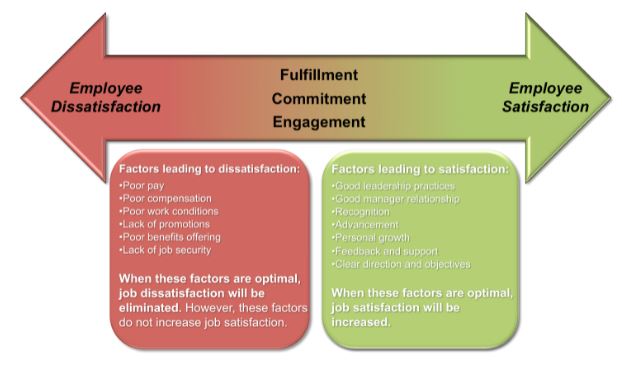
Main Causes Of Satisfaction and Dissatisfaction Amongst Employees At The Zorlu Textile Company (2008)
Satisfaction And Dissatisfaction Amongst Employees Dissertation – This is a descriptive study looking into the impact of motivation on job satisfaction. The management dilemma in many organizations in today’s fast paced technological environment is how managers can improve the motivation of employees, so that companies employ and retain a fulfilled workforce that contributes optimally to organizational stakeholders. Essentially, the questions that must be answered by this research are:
- What makes some employees perform better than others?
- What makes some employees seem better satisfied in their jobs than others?
- In what ways can management improve the motivation of its employees?
Some of the benefits of this research for managers as well as organizations include:
- It will broaden management’s insights that motivation plays a key role in the overall job satisfaction of employees.
- It will enable managers to understand the factors and processes that are internal and external to the individual employee in an organization that have an effect in his/her behaviour and performance.
- By understanding motivational issues behind employees, managers can systematically develop strategies to deal with motivational problems.
- The results of this investigation can help companies’ lower turnover costs by addressing motivational concerns of employees. The consequence is that employees will stay and not resign the company.
- Replacing an experienced and trained worker can be very costly for organization.
The concept of motivation has been utilized to explain types of behaviour, for example, basic biological needs or drives connected to survival and procreation (e.g. hunger, thirst and sex) and extrinsic rewards or punishments. Both types of explanations suggest that behaviour is motivated by the need or desire to achieve particular outcomes (e.g. promotion, recognition and avoidance of punishment). Therefore, motivation energizes and guides behaviour toward reaching a particular goal.
Many academics say motivation is a concept we use when we describe the forces acting on or within an individual to initiate and direct behavior. We use the concept to explain differences in the intensity of behavior (regarding more intense behaviors as a result of higher levels of motivation) and also to indicate the direction of behavior (e.g., when you’re tired or sleepy, you direct your behavior toward getting some sleep). Without motivation even the most talented people will not deliver to their potential. With motivation, others will perform way above the level expected of their intelligence and academic ability.
- 20,000 words – 85 pages in length
- Excellent use of literature
- Excellent use of models
- Good in depth analysis
- Includes questionnaire
- Ideal for HRM students
1: Introduction and Motivation
Problem statement
Purpose and importance of the study
Research objectives
Primary objective
Secondary objectives
Research hypothesis
Differentiation and scope of the study
Key concepts
Motivation
Job satisfaction
Research design
Data collection
Survey technique
Interview technique
Secondary data technique
Sampling
Target population
Sampling frame
Sample size
Data analysis
Drawing conclusions and making recommendations
2: Literature Review Part One – Motivation
Process theories of motivation
Social learning theory
Operant conditioning
Expectancy theory
Equity theory
Goal setting theory
Job design theory
Content theories of motivation
Maslow’s Hierarchy of Needs
Alderfer’s ERG theory
McClelland’s learned theory of needs
McGregor’s Theory X and Theory Y
Ouchi’s Theory Z
Herzberg’s Two-Factor Theory
Other literature of work motivation
Literature Review Part Two – Job Satisfaction (Dissatisfaction)
Theories of job satisfaction and dissatisfaction
VIE Theory
Comparison Theory
Opponent Process Theory
High Performance Cycle Theory
Other literature on job satisfaction (or dissatisfaction)
3: Research Design and Procedure
Research design
Target population and sampling procedure
Sample size
Sampling frame
Data collection
Survey technique
The measuring scale
Secondary data technique
Data analysis
4: Findings
Overview of the Zorlu Holding Company
Methodology
Data collection
Sample and sample characteristics
Age
Gender
Marital Status
Work experience
Education
Position
Location
Analysis
Findings
Satisfaction Rate
Employees Intention to work in Zorlu
Distribution of factors
5: Interpretation, Conclusions and Recommendations
Introduction
Interpretation
Conclusions
Factors causing satisfaction
Integration
Recommendations
Achievement
Recognition
Work itself
Company policy and administration
Interpersonal relations
References